

Surveillance video often becomes the strongest piece of evidence in an investigation, but only if it is collected, handled, and documented correctly from the moment it is recorded. Whether supporting an insurance investigation, civil litigation, workplace inquiry, or criminal case, professional surveillance footage must withstand legal scrutiny long before it reaches a courtroom. This process involves preserving the original recording, maintaining its integrity, documenting chain of custody, and presenting the evidence in a manner that can be authenticated. Silverstone Investigations applies these principles during surveillance operations throughout Oklahoma to help ensure video evidence remains reliable and legally defensible.
What is considered video evidence?
Video evidence is any recorded footage that may be used in an investigation or legal proceeding. It may come from surveillance operations, business security cameras, residential security systems, doorbell cameras, dash cameras, cell phones, body-worn cameras, or other recording devices. Regardless of its source, once a recording may become evidence, it should be documented, reviewed, organized, and preserved to maintain its evidentiary value.
A clear recording may document a subject’s activities, establish a timeline, or contradict a disputed claim, but its value depends on how the footage was collected, documented, and maintained after it was recorded.
How investigators collect and preserve video evidence
Acquisition errors cause most downstream investigative failures. The moment you copy a file incorrectly, you risk losing the metadata that proves when and where it was recorded. That loss can make otherwise strong footage inadmissible.
After a surveillance operation, investigators should immediately secure the original recording from the recording device whenever possible. You preserve the original file structure, embedded timestamps, GPS data if present, and codec information. A quick copy to a USB drive or a re-encoded export strips much of this context away.
Key acquisition practices include:
- Preserve original files. Never work from a copy as your primary evidence. Create a forensic duplicate and work from that.
- Avoid re-encoding. Converting video to a different format degrades metadata and can introduce artifacts that raise authenticity questions.
- Check proprietary formats early. Some CCTV systems export footage in proprietary formats that require the manufacturer’s own playback software. Confirm compatibility before you need it in court.
- Document every action. Record the device, the operator, the date, the method of extraction, and the storage location.
Pro Tip: Start your chain of custody documentation at the moment of acquisition, not after. A gap at the beginning is the hardest gap to close later.
Chain of custody is not bureaucratic paperwork. It is the paper trail that answers every challenge an opposing attorney will raise. Without it, even authentic footage becomes vulnerable.
Reviewing and Analyzing Video Footage
Reviewing video evidence is not the same as watching a video. Effective analysis requires a systematic approach that produces a formal record, not just a mental impression. The goal is a viewing log: a timestamped document that notes every meaningful event, the frame or timecode where it occurs, and a factual description.
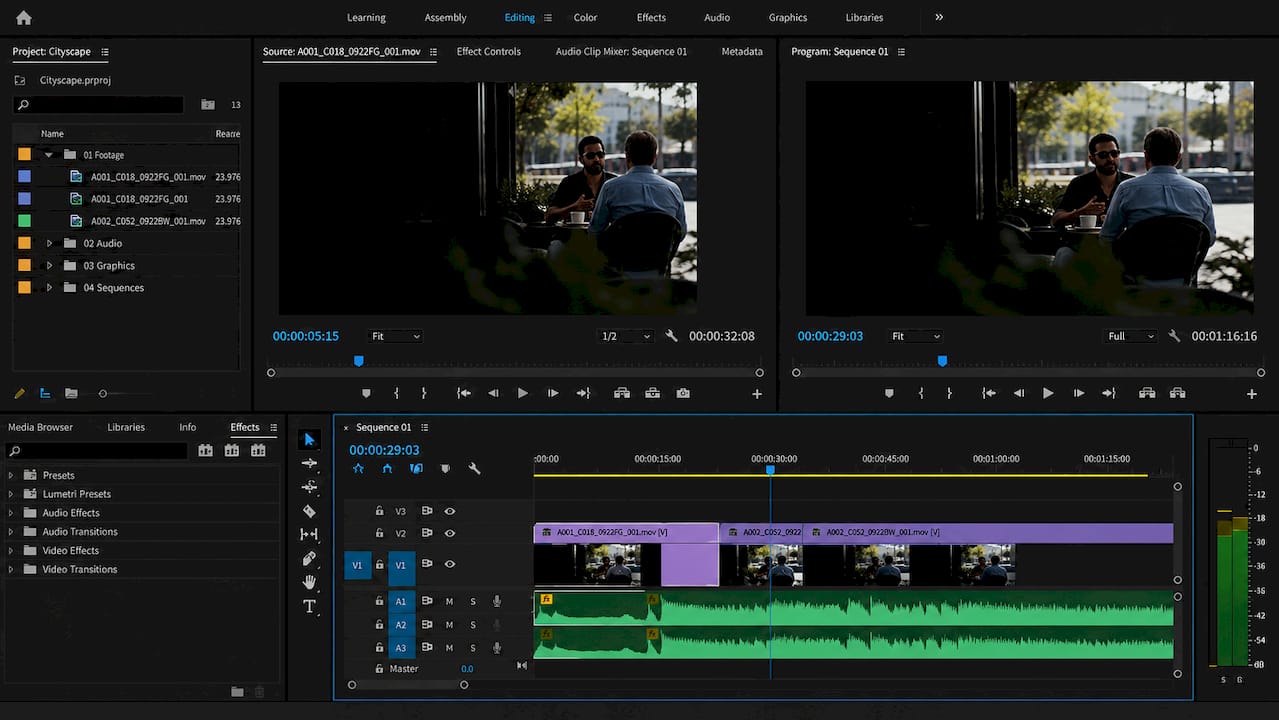
Viewing logs with timestamped notes are often more persuasive in court than edited highlight clips. A log demonstrates that the investigator reviewed all footage, not just the segments that support one side. That transparency directly counters claims of cherry-picking.
A thorough review process covers:
- Full footage review. Watch everything within the relevant time window before extracting clips. Missing a key event because you skipped ahead is a common and costly error.
- Timecode documentation. Note exact timecodes for every event of interest. Vague references like “around the 10-minute mark” do not hold up under cross-examination.
- Proprietary playback checks. Confirm that the playback software renders the footage accurately. Some systems display incorrect timestamps in third-party players.
- Multi-camera synchronization. When multiple cameras cover the same area, synchronizing feeds across a single timeline reveals inconsistencies and fills gaps that any single angle would miss.
The synchronization step is where investigations often shift. An incident that looks ambiguous from one camera angle becomes clear when a second feed is aligned to the same timeline. Building that unified narrative is what separates a thorough investigation from a surface review.
How does AI support video evidence analysis?
AI-powered video analysis accelerates footage triage by tagging objects, tracking individuals, and transcribing audio in a fraction of the time manual review requires. For investigations involving hours of footage across dozens of cameras, that speed is significant.
AI tools can identify and flag:
- People and vehicles by appearance or license plate
- Audio segments containing specific keywords or phrases
- Motion events within defined zones or time windows
- Faces and license plates for automatic redaction
AI-enabled automatic redaction helps comply with privacy laws by blurring faces and plates at scale, with human reviewers confirming the output. This reduces the manual frame-by-frame work that previously made large-scale footage review impractical.
Pro Tip: Treat AI output as a starting point, not a conclusion. Use it to surface the segments worth reviewing closely, then apply human judgment to every finding before drawing any evidentiary conclusion.
AI is a triage tool. It does not build legal narratives, and it does not replace investigator judgment. Human review remains essential because courts evaluate conclusions drawn by people, not algorithms. AI gets you to the relevant footage faster. The investigator determines what that footage means.
What legal standards govern video evidence?
Admissibility is the threshold every recording must satisfy before a court considers it. The question is not whether the footage is compelling, but whether it can be authenticated. In Oklahoma, authentication is governed by 12 O.S. § 2901 of the Oklahoma Evidence Code, which was modeled after Federal Rule of Evidence 901. Both require the party offering the evidence to establish that the recording is what it is claimed to be.
Authentication generally focuses on three key areas:
- Source identification. The proponent must establish which device captured the footage and demonstrate that the recording system was operating reliably.
- Integrity of the evidence. The footage should be shown to have remained materially unchanged after collection. Metadata, hash values, audit logs, and witness testimony are common methods used to support its authenticity.
- Documented chain of custody. The handling of the evidence should be documented from collection through presentation to help establish authenticity and address claims of tampering.
One recognized method of authenticating video evidence is explaining the system or process used to produce it. Investigators strengthen authentication by documenting how the footage was recorded, collected, handled, and maintained.
Spoliation is the failure to preserve evidence that a party knew or should have known was relevant to anticipated litigation. Courts may impose sanctions when relevant footage is lost or improperly preserved.Failure to preserve relevant footage from different angles or extended time windows can result in spoliation sanctions. The scope of what you must preserve is broader than most people expect. If an incident occurred at 2:15 p.m., preserving only that two-minute clip is not enough. Courts have penalized parties who failed to retain footage from adjacent cameras or the hour before and after the incident. Preserve broadly and early. The legal investigations process at Gosilverstone is built around this principle.
Tools and workflows for managing video evidence
Professional video investigation workflows follow a consistent structure regardless of the software used. The process moves from intake to analysis to reporting, with documentation at every stage.
| Workflow stage | Key actions |
|---|---|
| Intake and preservation | Create forensic copy, verify hash values, log chain of custody |
| Metadata analysis | Extract timestamps, GPS data, codec details, and device identifiers |
| Frame and subclip marking | Tag key events with timecodes, extract relevant segments for review |
| Processing | Crop, resize, or enhance footage without altering the original file |
| Multi-camera synchronization | Align feeds from different cameras to a single timeline |
| Report generation | Produce a narrative report embedding video assets, timelines, and findings |
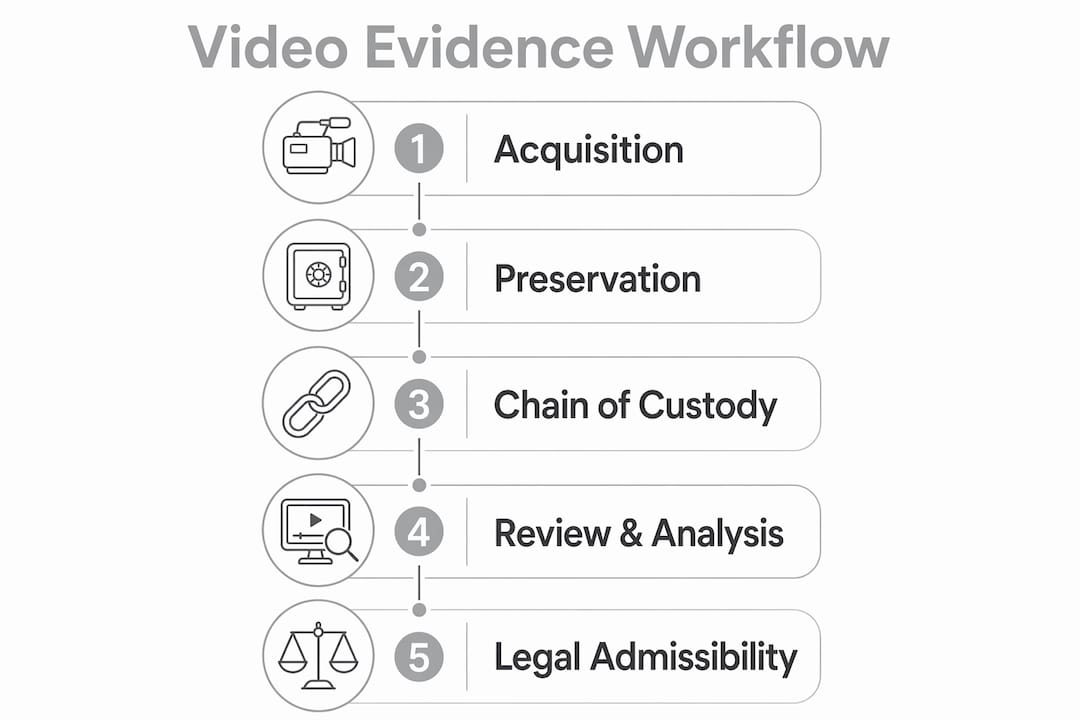
Investigation tools include features for marking frames and subclips, metadata analysis, resizing, cropping, multi-camera synchronization, and narrative report generation. The report stage is often underestimated. A well-structured report that embeds video assets alongside a written timeline is far more useful in litigation than raw footage handed to an attorney without context.
Technology advances support both investigative accuracy and legal defensibility. Audit trails built into professional tools record every action taken on a file, which directly supports chain of custody documentation and addresses the authentication challenges.
Why acquisition discipline separates defensible cases from failed ones
Across surveillance investigations involving insurance claims, civil litigation, workplace incidents, and fraud cases, one pattern appears repeatedly: the cases that fall apart almost always trace back to a handling error at the very beginning. Not a bad camera angle. Not missing footage. A bad copy made by someone who thought they were being helpful.
The instinct to grab a quick export and move on is understandable. But that quick export often strips the metadata that proves the footage is authentic. Once that metadata is gone, you are arguing from a position of weakness in court, no matter how clear the footage looks.
Investigators sometimes over-rely on AI triage and skip thorough manual review. AI is genuinely useful for processing large volumes of footage quickly. But it surfaces candidates for review. It does not build a case. The investigator builds the case, and that requires watching the footage, logging events, and constructing a timeline that can withstand cross-examination.
The spoliation risk is the one that surprises people most. Clients often assume that preserving the obvious clip is enough. Courts disagree. Preserve everything within a reasonable scope of the incident, including adjacent cameras and extended time windows, before you know exactly what is relevant. Claims evolve. What seems irrelevant on day one can become central by the time of trial.
FAQ
What is surveillance video evidence?
Surveillance video evidence is footage recorded during a surveillance operation that may later be used as evidence in legal proceedings. Its value depends not only on what the camera captures, but also on how the footage is documented, handled, and preserved after it is collected.
What makes video evidence admissible in court?
Federal Rule of Evidence 901 and 12 O.S. § 2901 of the Oklahoma Evidence Code, require proof of authenticity, integrity, and an auditable chain of custody. Courts evaluate the process used to collect and handle the footage, not just its content.
What is spoliation of video evidence?
Spoliation is the failure to preserve relevant footage that a party knew or should have known was material to litigation. Courts may impose sanctions, including adverse inference instructions, when footage is lost or inadequately preserved.
How does AI help with video evidence analysis?
AI tools tag people, vehicles, and audio segments to speed up triage across large volumes of footage. Human investigators must verify every AI-flagged finding before drawing any evidentiary conclusion.
How long should video evidence be preserved?
Preserve footage from the incident time window, adjacent cameras, and a reasonable period before and after the event. The scope of what is relevant can expand as claims develop, so broad early preservation reduces spoliation risk.
For more information about surveillance, video evidence, or investigative services, contact Silverstone Investigations.